

A target of 3,000 pieces per day is not achieved by placing more operators around the casting line. Slip supply, mould drainage, pressure casting, demoulding, handling and quality feedback must run to one coordinated rhythm. High-pressure casting can shorten forming time and increase mould utilization, but the shorter cycle matters only when it becomes continuous qualified output.
Doubling efficiency and halving direct labor can be an improvement target, not a universal promise. The actual result depends on product geometry, pieces per cycle, cycle time, equipment availability, first-pass quality, changeover frequency, and the ability of finishing, drying, glazing and firing to absorb the added flow.
| The capacity target must first be converted into a qualified-output rate. Over 24 continuous hours, 3,000 qualified pieces equal an average of 125 pieces per hour. When planned production time is shorter than 24 hours, the required hourly rate increases. This is only target decomposition, not proof that the equipment has enough capacity. | 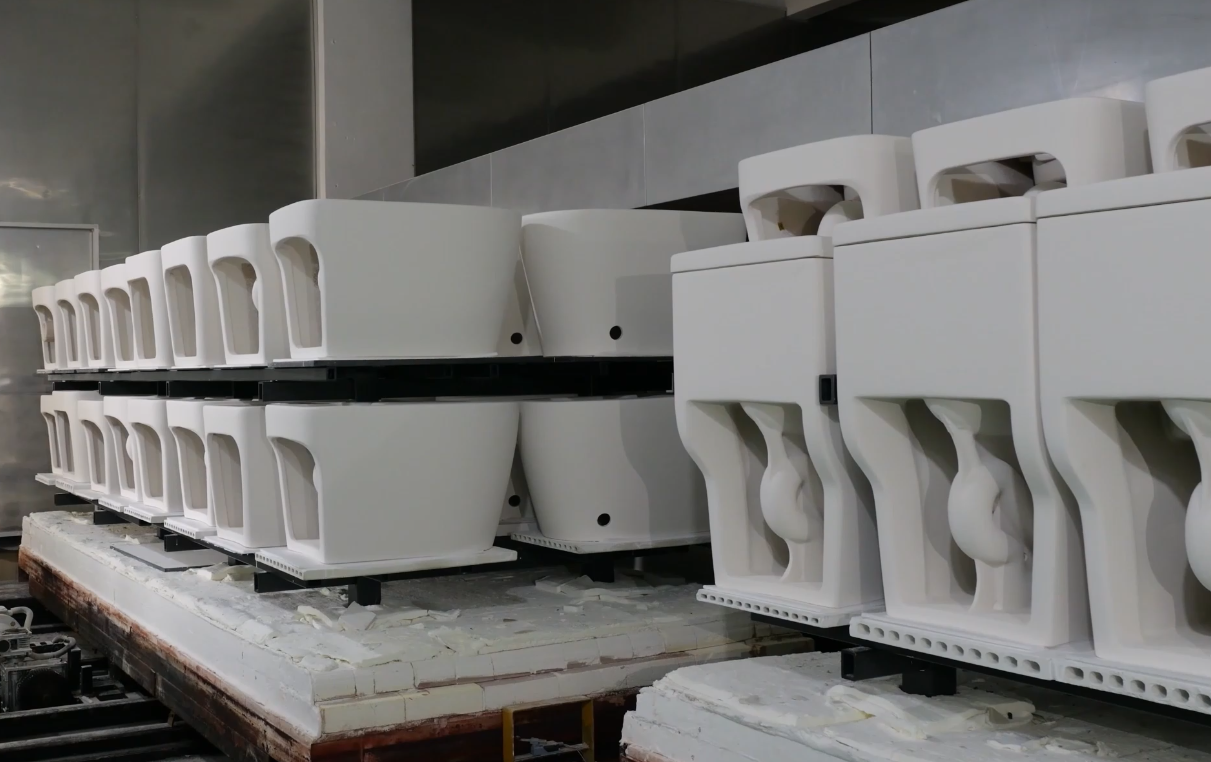 |
The capacity target must first be converted into a qualified-output rate. Over 24 continuous hours, 3,000 qualified pieces equal an average of 125 pieces per hour. When planned production time is shorter than 24 hours, the required hourly rate increases. This is only target decomposition, not proof that the equipment has enough capacity.
Capacity should be calculated from qualified output rather than casting counts:
Daily qualified output = effective running time of all forming units / actual cycle time x qualified pieces per cycle
Effective running time excludes changeovers, cleaning, waiting, failures and planned maintenance. Qualified pieces per cycle must also reflect losses during forming, demoulding and downstream processing. Multiplying a nominal machine cycle by 24 hours will usually overstate deliverable output.
Conventional plaster-mould slip casting relies on water absorption to form the body layer, while mould condition and drying constrain reuse. High-pressure casting uses pressure to drive liquid through a porous mould, depositing solids at the mould wall. Filling, pressure increase, holding, draining, depressurizing and opening can be controlled as a defined sequence.
Research on sanitary ware has shown that pressure casting can substantially reduce forming time compared with plaster casting. The important change is not simply a faster machine. The same mould can repeat a controlled cycle, while demoulding, handling and process records can be integrated more readily.
Adding operators may increase the parallel execution of manual tasks, but it does not fundamentally shorten body-formation time or remove differences in timing, judgment and operating sequence. Pressure casting builds productivity around a repeatable process cycle and coordinated equipment.
Capacity variable | What must be recorded | Effect on daily output |
Actual forming cycle | Filling, pressurizing, body formation, draining, depressurizing, opening and reset time | Determines theoretical cycles per machine per day |
Qualified pieces per cycle | Cavity count, demoulding loss, green-body defects and downstream scrap | Determines whether cycles become qualified products |
Equipment availability | Failures, waiting, cleaning, changeovers, mould service and planned stops | Determines how much scheduled time is productive |
Product mix | Product size, geometric complexity, mould format and changeover frequency | Determines whether different orders can share one rhythm |
Downstream capacity | Finishing, drying, glazing, kiln loading, firing and inspection capacity | Determines whether added casting output becomes excess work in process |
All five variables need the same statistical boundary. If forming reports demoulded quantity while quality reports fired qualified products, the two departments are not measuring the same daily output.
| Pressure casting can reduce repetitive casting, timing, draining and handling tasks. It does not mean that half the workforce should be removed before the process is stabilized. After automation, work shifts toward slip verification, mould maintenance, recipe control, exception handling, inspection and preventive maintenance. |  |
When product geometry is complex, orders change frequently, slip varies or downstream operations remain highly manual, shorter pressure-casting cycles can be offset by waiting, repair and congestion. Capacity and labor targets therefore require validation with plant data.
High-pressure forming remains sensitive to slip condition. Viscosity, thixotropy, temperature, water quality and ageing can affect filling, filtration, green-body density and demoulding strength. Changes in slip preparation may alter both casting rate and green properties.
Mould drainage, cleanliness, operating cycles, sealing and maintenance also influence the actual cycle. An unstable slip may force operators to extend holding time, slow the line or accept more repair. Unequal mould condition can produce different wall thickness and demoulding results under the same recipe.
An automated line therefore needs stable slip testing and mould management before speed is increased. A machine can repeat its inputs, but it cannot automatically correct unidentified material and process variation.
Yes. Once forming accelerates, congestion may first appear in finishing, followed by dryer loading, glazing transfer, kiln loading or inspection and packing. Without coordinated planning, 3,000 pieces per day can become 3,000 pieces of work in process rather than 3,000 deliverable products.
Before expansion, the plant should map the rhythm from slip preparation to packing and answer at least these questions:
· How many qualified pieces can each operation receive and release per hour?
· How long can intermediate buffers absorb a short stop?
· Will a product change consume mould, fixture and conveyor positions at the same time?
· Do drying and firing batches match the forming rhythm?
· Which failure will force the whole line to slow or stop?
System capacity is defined by the weakest effective operation. Adding forming equipment alone does not create stable delivery capacity when downstream constraints remain.
ISO 22400-1 provides a general framework for manufacturing-operations KPIs and can help a plant align metric definitions, data sources and intended uses. It does not prescribe pressure-casting parameters or prove that a line will reach 3,000 pieces, but it can support a comparable capacity-data system.
The daily target should be supported by records of:
· Qualified output, first-pass results, repair and scrap;
· Planned production time, actual running time and stop reasons;
· Actual cycles, waiting time and changeover time;
· Equipment, mould and product-model relationships;
· Direct labor hours per qualified piece and exception-support hours;
· Work in process between forming, drying, glazing and firing.
NIST research on KPI hierarchies shows that efficiency, throughput, availability, quality and maintenance measures are interdependent. A pressure-casting line should therefore evaluate speed together with quality and downtime rather than optimize one measure in isolation.
First, establish a baseline with existing products. Record actual cycle time, availability, first-pass results, direct labor and downstream waiting by product model instead of relying on estimates.
Second, select a product with stable geometry, continuous demand and good standardization potential for the pilot. Confirm the slip, mould and demoulding window before integrating handling, finishing and quality records step by step.
Third, calculate the required forming units and downstream capacity for the target product mix, allowing time for changeovers, maintenance and exceptions. Capacity design should use sustainable operation rather than a short peak rate.
Fourth, validate qualified output and direct labor in stages. Doubling efficiency and halving labor can be confirmed only when quality, rhythm, availability and safety requirements are met during continuous production.
A target of 3,000 pieces per day is a production-system problem, not a simple equipment-count problem. High-pressure casting can shorten cycles, raise mould utilization and reduce repetitive manual tasks, but real capacity requires stable slip, reliable moulds, available equipment, balanced downstream operations and a closed quality loop.
Moving beyond a labor-heavy strategy does not reduce the value of people. It shifts their work from repetition to process control, maintenance and problem solving. When improvement is measured by qualified output instead of theoretical cycles, pressure-casting speed can become stable delivery capacity.