

In sanitary ware production, deformation usually does not suddenly appear during firing. It is gradually accumulated through forming, drying and firing. Uneven wall thickness, moisture difference, inconsistent drying speed, kiln temperature variation and poor support can all change the final dimensions and shape.
1. Forming Defines the Deformation Foundation
Forming determines the structure of the green body. Casting time, slip density, flowability, mold absorption, draining rhythm and demolding strength all affect wall thickness and moisture content. If different areas of the same product have large wall-thickness variation, they will shrink differently during drying and firing. Complex products such as one-piece toilets, wall-hung toilets and large basins are more sensitive because they have larger spans, more stress points and more difficult support conditions. Early deformation may | 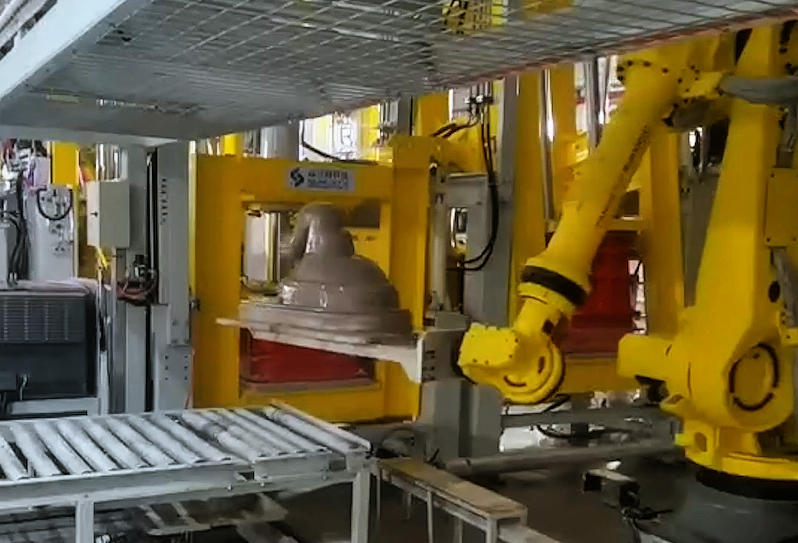 |
2. Drying Amplifies Uneven Shrinkage
Drying is not just water removal. It is the controlled migration of moisture through the ceramic body. Digitalfire’s explanation of drying shrinkage notes that clay bodies shrink as they move from wet to dry condition. If the surface dries before the inside, or thin areas shrink earlier than thick areas, tensile stress may develop, causing warping, hidden cracks or local deformation.
Solving drying deformation is not only about extending drying time. It requires control of temperature, humidity, airflow, product placement and support method. Different products need different drying rules. Products with large wall-thickness variation, internal cavities or strict mounting surfaces require dedicated setters and staged drying curves.
3. Firing Determines Final Dimensions
Shrinkage continues during firing. Digitalfire’s explanation of firing shrinkage states that particles draw together during drying, and the body continues to densify and shrink during firing. If firing curve, kiln temperature uniformity, kiln position, support points or cooling schedule are unstable, products may show warping, twisting, dimensional deviation or uneven mounting surfaces.
Digitalfire’s body warping reference also notes that warping is often related to vitrification and insufficient preventive measures during forming and firing. Therefore, firing deformation management should not focus only on peak temperature. It must also consider heating rate, soaking time, kiln-car support, cooling curve and product position inside the kiln.
4. Deformation Control Requires a Closed Process Loop
| Sunlets sanitaryware cover body and glaze preparation, casting, automatic finishing, glazing and firing, showing that modern sanitary ware production is an integrated process system. The academic study Ceramic sanitary wares: Prediction of the deformed shape after firing also describes sanitary ware production through forming, drying and firing, with special focus on predicting deformation after firing. | 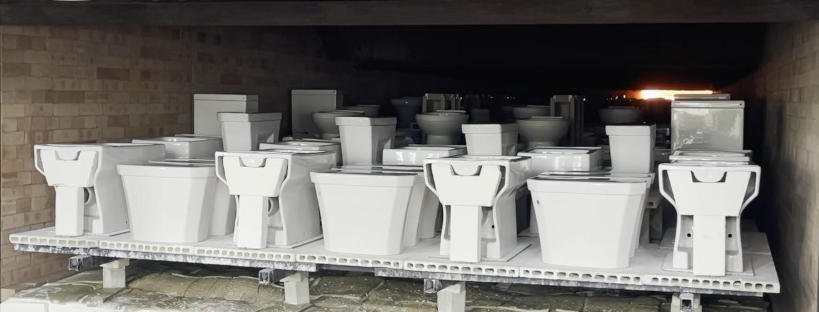 |
Conclusion
Products deform repeatedly because shrinkage, stress and support are not controlled as one system. Forming determines wall thickness and moisture distribution. Drying determines early shrinkage stability. Firing determines final densification and dimensions. For ceramic sanitary ware factories, deformation control does not come from final correction. It comes from standardized process parameters, optimized structural support and traceable quality data.